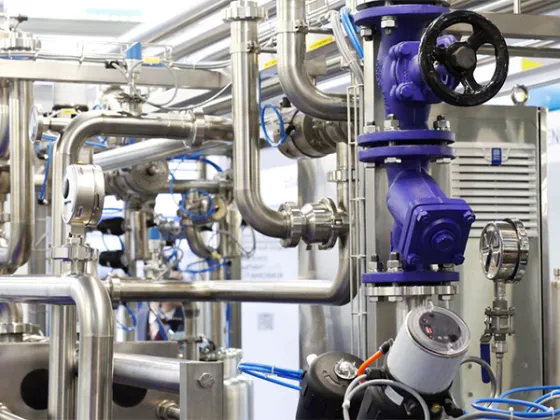
What is a Cast Iron Gate Valve?
A cast iron gate valve is a type of linear motion valve used primarily to start or stop fluid flow. It is not designed for regulating or throttling flow. The name comes from two key features:
-
Body Material: The valve body is made from cast iron, typically gray iron (ASTM A126 Class B) or ductile iron (ASTM A395).
-
Function: It uses a “gate” (a solid wedge or disc) that is raised or lowered by a handwheel to open or close the flow path.
Key Components
-
Body: The main pressure-containing part, cast from iron. It houses all the internal components and has connections (flanged, threaded, or grooved) to the piping system.
-
Bonnet: The cover that is bolted or screwed to the body, forming a pressure-tight seal. It contains the stem packing and guides the stem.
-
Stem: A threaded rod that connects the handwheel to the gate. It translates the rotary motion of the handwheel into the linear motion of the gate.
-
Gate (or Disc): The solid block that moves perpendicular to the flow to block it. Common types are solid wedge, flexible wedge, or split wedge.
-
Handwheel: The manual operator used to open or close the valve.
-
Packing: A seal (often graphite or PTFE) around the stem that prevents fluid from leaking out of the valve.
How It Works
-
Opening: Turning the handwheel counter-clockwise raises the stem, which lifts the gate completely out of the flow path. This creates a full, unobstructed bore, resulting in very low pressure drop.
-
Closing: Turning the handwheel clockwise lowers the stem, forcing the gate down into the seat until it forms a tight seal, stopping the flow.
Crucial Point: A gate valve is designed to be either fully open or fully closed. Operating it in a partially open position can cause vibration, cavitation, and erosion of the gate and seats, leading to premature failure.
Advantages of Cast Iron Gate Valves
-
Cost-Effective: Cast iron is a relatively inexpensive material, making these valves a very economical choice for many non-critical applications.
-
Low Pressure Drop: When fully open, the gate is completely out of the flow path, offering minimal resistance and a nearly straight-through flow. This minimizes energy loss in the system.
-
Bi-Directional Flow: Most standard gate valves can handle flow from either direction.
-
Good for Slurries: The straight-through design is less likely to trap solids, making them suitable for viscous fluids or slurries (with the right wedge type).
Disadvantages and Limitations
-
Not for Throttling: As mentioned, using them to regulate flow damages the valve.
-
Slow to Operate: Requires many turns of the handwheel to go from fully open to fully closed.
-
Prone to Seizing/Corrosion: In water applications, cast iron is susceptible to internal rust (corrosion). Over time, this can seize the gate in place, making the valve inoperable. This is a significant drawback for long-term or critical services.
-
Occupies More Space: The stem must rise to the full height of the gate, requiring more vertical space compared to a ball valve or butterfly valve.
-
Vibration can Loosen Seat: In systems with high vibration, the gate can “chatter” against the seats, potentially breaking the seal.
Common Applications
Due to their cost-effectiveness and full-flow design, cast iron gate valves are widely used in:
-
Potable Water Distribution Systems (though ductile iron is more common for mains today).
-
Fire Protection Systems (sprinkler systems).
-
Irrigation and Waterworks.
-
Industrial Water Lines (cooling water, process water).
-
Wastewater and Sludge Handling.
-
Heating, Ventilation, and Air Conditioning (HVAC) systems.
Important Note: They are not suitable for steam, corrosive chemicals, or high-pressure/temperature applications.
Cast Iron vs. Ductile Iron Gate Valves
This is a critical distinction. While both are iron-based, their properties are very different.
Recommendation: For any critical or modern application, Ductile Iron is almost always the preferred choice over gray cast iron due to its superior strength and safety.
Buying Considerations
-
Type of Iron: Specify Gray Iron or Ductile Iron based on pressure and application requirements.
-
End Connections: Flanged is most common for larger sizes; threaded or grooved ends are used for smaller pipes.
-
Wedge Type: Solid wedge (general purpose), flexible wedge (for temperature variations to prevent sticking), or split wedge (for better sealing on uneven seats).
-
Stem Type: Rising Stem (OS&Y – Outside Stem & Yoke) where the stem rises as you open it (shows visual position) vs. Non-Rising Stem (NRS) where the stem does not rise (good for tight spaces).
Summary
A cast iron gate valve is a simple, economical, and effective workhorse for on/off service in low to moderate pressure water and wastewater applications. Its main drawbacks are its susceptibility to corrosion and its unsuitability for flow control. When selecting one, always consider upgrading to a ductile iron body for greater longevity and reliability.