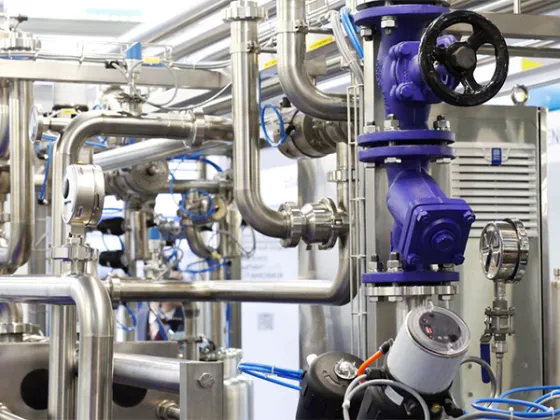
What is a Forged Steel Gate Valve?
A forged steel gate valve is a type of industrial valve designed primarily for on/off service, not for flow regulation. Its name comes from two key aspects:
-
Forged Steel: The valve body and bonnet are manufactured through a forging process. This involves heating a solid piece of carbon steel or alloy steel and shaping it under high pressure. Forging creates a denser, stronger, and more robust grain structure compared to casting, making it ideal for high-pressure and high-temperature applications.
-
Gate Valve: The valve operates by lifting a rectangular or circular “gate” (the disc) out of the path of the fluid. When fully open, it offers minimal flow resistance and a straight-through flow path, resulting in very low pressure drop.
Key Features and Design
-
Rising Stem (OS & Y): Most forged steel gate valves feature an Outside Screw and Yoke (OS&Y) design. As the handwheel is turned, the stem rises visibly, providing a clear visual indication of whether the valve is open or closed. The threaded part of the stem is outside the valve body and flow path, protecting it from corrosive media.
-
Body-Bonnet Joint: Common types include:
-
Bolted Bonnet: Standard for most applications.
-
Pressure-Seal Bonnet: Used for very high-pressure services (typically > 2,500 psi). The internal pressure helps create a tighter seal.
-
Gate/Disc Types:
-
Solid Wedge: The most common type, suitable for most fluids, including steam.
-
Flexible Wedge: A cut around the perimeter allows the gate to flex slightly, improving sealing and compensating for minor changes in seat alignment due to thermal expansion or pipe stress.
-
Seat Rings: The seats are often hard-faced with materials like Stellite (a cobalt-chromium alloy) to resist erosion and wear, especially in high-temperature steam service.
Advantages of Forged Steel Gate Valves
-
High Strength & Durability: The forged construction provides superior mechanical strength, impact resistance, and structural integrity.
-
Suitable for High Pressure/Temperature: They are the go-to choice for demanding services found in power generation, oil & gas, and petrochemical plants.
-
Low Pressure Drop: When fully open, the straight-through flow path creates minimal resistance to flow.
-
Bidirectional Flow: They can be installed in either flow direction, offering flexibility in piping design.
-
Excellent Shut-Off: Provides a tight, leak-proof seal when fully closed.
Disadvantages and Limitations
-
Not for Throttling: Operating the valve in a partially open position causes vibration, cavitation, and rapid erosion of the gate and seats, leading to premature failure.
-
Slow Operation: Opening and closing requires many turns of the handwheel, making them slower to operate than quarter-turn valves (like ball or butterfly valves).
-
Prone to Seat and Gate Damage: If foreign particles are present in the fluid, they can score the seating surfaces.
-
Occupies More Space: The rising stem design requires more vertical space for operation compared to non-rising stem valves.
-
Higher Cost: The forging process and robust construction make them more expensive than cast steel or iron valves.
Common Applications
Forged steel gate valves are used in severe and critical services where reliability under extreme conditions is paramount.
-
Power Generation: Main steam lines, feedwater systems, and boiler blowdown.
-
Oil & Gas Production: Wellheads, Christmas trees, and process lines.
-
Refining & Petrochemical: High-pressure process units, refinery fuel systems.
-
High-Pressure Steam Systems: In various industrial plants.
-
Industrial Process Lines: For corrosive or high-pressure fluids.
Common Material Grades and Specifications
Summary: Forged Steel Gate Valve vs. Cast Steel Gate Valve
In conclusion, a forged steel gate valve is a premium, high-performance valve designed for reliability in the most demanding industrial environments where failure is not an option. Its strength, derived from the forging process, makes it indispensable for high-pressure and high-temperature on/off applications.