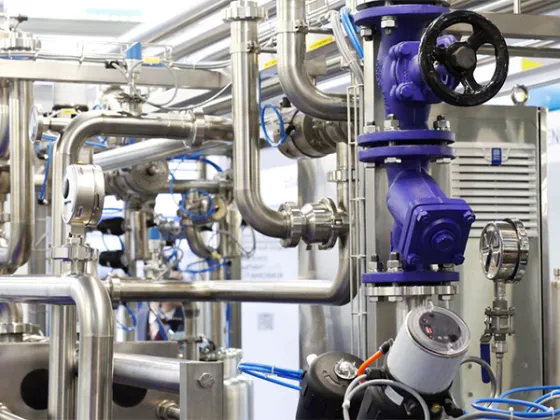
What is an OS&Y Gate Valve?
An OS&Y Gate Valve (Outside Stem & Yoke) is a type of linear motion valve used primarily for on/off service, not for flow regulation. Its most distinguishing feature is a threaded stem that is visually exposed, which moves in and out of a handwheel as the valve is operated.
The “Yoke” is a housing that supports the stem and provides a path for the stem to travel. The “Outside Stem” is the key visual indicator.
Key Components and How It Works
-
Handwheel: The wheel turned by the operator to open or close the valve.
-
Stem: A threaded shaft connected to the gate inside the valve body.
-
Yoke: The structural frame that connects the bonnet to the handwheel assembly and houses the stem nut.
-
Stem Nut: The fixed nut inside the yoke that the threaded stem travels through.
-
Gate (or Disc): The component that moves up or down to block or allow flow.
-
Bonnet: The cover that is bolted or threaded to the valve body, providing a leak-proof seal.
How it Works:
-
Opening the Valve: When you turn the handwheel counter-clockwise, the threaded stem rises out of the yoke. This lifts the gate completely out of the flow path, creating an unobstructed, full-bore opening. This minimizes pressure drop when fully open.
-
Closing the Valve: When you turn the handwheel clockwise, the stem moves down into the yoke, forcing the gate down into the valve seats, shutting off the flow.
The Critical Visual Indicator
This is the most important feature of an OS&Y valve:
-
Stem Visible and Up = Valve is OPEN. When the threaded stem is fully extended and visible above the yoke, the gate is lifted, and fluid can flow.
-
Stem Not Visible (Down) = Valve is CLOSED. When the stem is threaded down into the yoke and not visible, the gate is seated, and flow is blocked.
This provides a clear, at-a-glance, and fail-safe visual indication of the valve’s status, which is crucial for safety and operational efficiency.
Advantages of OS&Y Gate Valves
-
Clear Visual Indication: The position of the stem instantly tells an operator if the valve is open or closed, preventing dangerous mistakes.
-
Easy Maintenance: The packing (the seal around the stem that prevents leaks) can be easily inspected and repacked or replaced while the valve is under pressure because the stem moves out of the packing.
-
Durability: The design is robust and well-suited for high-pressure and high-temperature applications, common in industrial settings.
-
Reliable Sealing: The rising stem does not rotate inside the packing, which reduces wear and tear on the packing material, leading to a longer service life and a more reliable seal.
Disadvantages
-
Space Requirement: The stem rises as the valve opens, requiring significant vertical clearance above the valve for operation. This can be a problem in tight spaces.
-
Susceptible to Damage/Dirt: The exposed stem thread can be vulnerable to corrosion, physical damage, and accumulation of dirt or debris if not properly maintained.
-
Slower Operation: Compared to a quarter-turn valve (like a ball valve), it takes many turns to fully open or close, making it slower to operate.
Common Applications
OS&Y gate valves are the industry standard for critical on/off services where knowing the valve’s status is essential. You will find them in:
-
Fire Protection Systems: This is the most common application. Building codes often require OS&Y valves on sprinkler system water supplies so firefighters can instantly see if water is available.
-
Water Supply Lines: For municipal water mains and industrial water systems.
-
Oil and Gas Pipelines: For isolation sections of pipeline.
-
Power Plants: In high-pressure steam and water lines.
-
Chemical Processing Plants: For various process lines.
OS&Y vs. Non-Rising Stem (NRS) Gate Valve
This is a key comparison:
Summary
In short, an OS&Y Gate Valve is a robust, reliable on/off valve whose primary benefit is the unmistakable visual indication of its open or closed status. Its design makes it a preferred choice for safety-critical applications like fire sprinkler systems and other industrial processes where knowing the flow position is paramount.