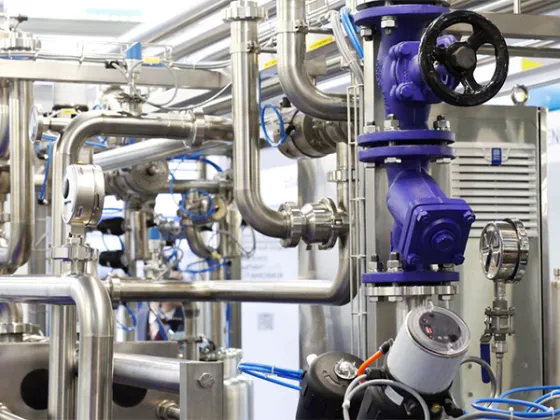
What is a Low Pressure Gate Valve?
At its core, a low pressure gate valve is a type of valve designed to fully stop or start the flow of a fluid (on/off service). It is not intended for flow regulation. Its defining characteristic is that it is engineered and built to handle systems with relatively low pressures, typically under 300 psi (20 bar), and often much lower.
The name comes from the “gate”—a solid, rectangular or circular disc (the wedge) that is lifted or lowered into the path of the flow.
Key Characteristics and Design Features
-
Rising vs. Non-Rising Stem:
-
Rising Stem (OS&Y – Outside Screw & Yoke): The stem threads are outside the valve body. As you turn the handwheel, the stem rises, providing a clear visual indicator of whether the valve is open or closed. This is common in industrial applications.
-
Non-Rising Stem (NRS): The stem threads are inside the valve body and engage with the gate. The handwheel rises and falls with the stem. This is compact and ideal for spaces with limited vertical clearance, like underground installations.
-
Wedge Types:
-
Solid Wedge: The most common type. A single, solid piece that is reliable and suitable for most low-pressure applications.
-
Flexible Wedge: The wedge has a cut around its perimeter, allowing it to flex slightly. This helps it seal better against minor distortions in the valve body due to temperature or pipe stress.
-
Split Wedge (or Parallel Disks): Two separate pieces that are forced outward against the seats when the valve is closed. Excellent for handling thermal expansion and are less prone to sticking.
-
Body Materials: Since pressures are low, materials can be more varied and often less expensive than those for high-pressure valves.
-
Cast Iron: Very common for water, air, and other non-corrosive services.
-
Ductile Iron: Stronger and more impact-resistant than cast iron.
-
Bronze/Brass: Excellent for plumbing, seawater, and corrosive fluids.
-
PVC / uPVC / CPVC: Ideal for chemical service, water treatment, irrigation, and highly corrosive environments. Very low cost and excellent corrosion resistance.
-
Seat Design: The sealing surface can be:
-
Metal-to-Metal: The wedge seals directly against the machined valve body. Durable but can be more prone to minor leakage.
-
Resilient Seat: A rubber (EPDM, NBR) or elastomer seat is inserted or bonded to the wedge or body. This provides a bubble-tight seal and is extremely common in low-pressure water applications.
How It Works (Operation)
The principle is very simple:
-
Opening the Valve: Turning the handwheel counterclockwise rotates the stem, which unscrews and lifts the gate vertically out of the flow path. This creates a full, unobstructed opening, resulting in very low pressure drop.
-
Closing the Valve: Turning the handwheel clockwise lowers the gate back down until it firmly seats in the valve body, blocking the flow completely.
Critical Rule: A gate valve should be used either fully open or fully closed. It should never be used to throttle (partially open) flow, as this will cause vibration, wire-drawing (erosion of the seat and disc), and rapid wear.
Advantages of Low Pressure Gate Valves
-
Low Pressure Drop: When fully open, the straight-through flow path offers minimal resistance.
-
Tight Shut-Off: A well-maintained gate valve provides an excellent seal against flow.
-
Simple Design & Operation: Easy to understand, manufacture, and repair.
-
Bi-Directional Flow: Most gate valves can be installed with flow in either direction.
-
Cost-Effective: For low-pressure services, they are generally less expensive than ball valves or globe valves of the same size.
Disadvantages and Limitations
-
Not for Throttling: Using it to regulate flow will quickly damage the valve.
-
Slow to Operate: Requires many turns of the handwheel to go from fully open to fully closed.
-
Occupies More Space: The linear movement of the stem requires more vertical space compared to a quarter-turn ball valve.
-
Potential for Seat and Disc Wear: The sealing surfaces can wear over time, leading to leakage.
-
Cavity and Potential for Solids Entrapment: The space around the gate can collect sediment or debris, which can make operation difficult and prevent a proper seal.
Common Applications
Low pressure gate valves are ubiquitous across many industries:
-
Water Supply & Distribution: In municipal water lines, building service lines, and fire protection systems.
-
Irrigation Systems: Controlling the flow in agricultural and landscape irrigation.
-
HVAC Systems: Isolating pumps, chillers, and coils in heating and cooling systems.
-
Industrial Plumbing: General on/off service for process water, air, and other utilities.
-
Chemical Processing (with compatible materials like PVC): Handling corrosive fluids at low pressures.
-
Oil & Gas (Low-Pressure Utility Lines): For utility water, air, or drainage lines within a facility.
Low Pressure Gate Valve vs. Ball Valve
This is a common point of confusion. Here’s a quick comparison:
In summary, a Low Pressure Gate Valve is a workhorse for simple on/off control in systems where pressure is not a primary concern. Its key strengths are its full-bore flow and tight shut-off, making it ideal for isolating sections of pipe in water, air, and other low-pressure utility services.