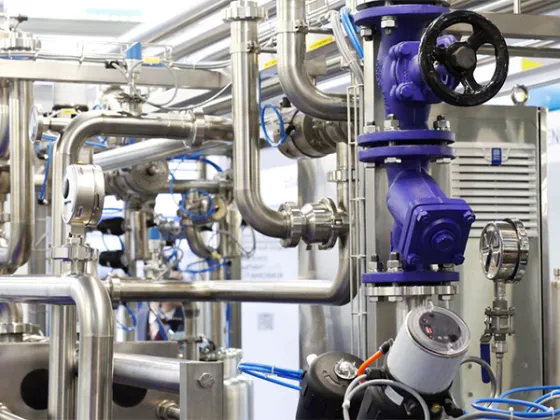
What is a Cast Iron Gate Valve?
A cast iron gate valve is a type of linear motion valve used primarily to start or stop fluid flow. It is not designed for regulating or throttling flow. The name comes from two key features:
-
Body Material: The valve body is made from cast iron, typically gray iron (ASTM A126 Class B) or ductile iron (ASTM A395).
-
Function: It uses a “gate” (a solid disc or wedge) that is raised or lowered by a handwheel and stem to open or close the flow path.
Key Components
-
Body: The main pressure-containing structure, cast from iron.
-
Bonnet: The cover that is bolted or screwed to the body, housing the stem and packing.
-
Stem: The rod that connects the handwheel to the gate. It can be rising (moves up as valve opens) or non-rising.
-
Gate (or Disc): The solid wedge or parallel disc that blocks the flow. Common types are solid wedge, flexible wedge, and split wedge (parallel disks).
-
Seat: The surface where the gate makes contact to form a seal. Seats can be integral to the body or made from resilient materials like brass (for better sealing).
-
Handwheel: Used to manually operate the valve.
-
Packing: A seal (often graphite or PTFE) around the stem that prevents leakage to the environment.
How It Works
The operation is very straightforward:
-
Opening: Turning the handwheel counterclockwise raises the gate out of the flow path, allowing full, unrestricted flow.
-
Closing: Turning the handwheel clockwise forces the gate down until it seals tightly against the seats, completely stopping the flow.
Because the gate retracts fully into the bonnet, it creates very little flow resistance when open, leading to minimal pressure drop.
Advantages of Cast Iron Gate Valves
-
Cost-Effective: Cast iron is a relatively inexpensive material, making these valves one of the most economical choices for many industrial and municipal applications.
-
Low Pressure Drop: When fully open, the straight-through flow path offers almost no obstruction, resulting in very low pressure loss.
-
Bi-Directional Flow: They can generally handle flow from either direction, simplifying installation.
-
Good for Slurries and Viscous Fluids: The shearing action of the gate helps it cut through thick fluids or fluids with suspended solids, unlike a ball valve which might get stuck.
-
Durability: Cast iron provides good strength and wear resistance for a wide range of non-corrosive services.
Disadvantages and Limitations
-
Not for Throttling: This is the most critical limitation. When partially open, the gate vibrates and chatters, causing rapid erosion of the seats and the gate itself. This quickly destroys the valve’s ability to seal.
-
Prone to Corrosion: Cast iron rusts (oxidizes) when exposed to water and moisture. It is not suitable for corrosive chemicals, seawater, or high-purity water systems.
-
Slow to Operate: Opening and closing requires many turns of the handwheel, which is slow compared to a quarter-turn valve like a ball valve.
-
Occupies More Space: The linear design and the height required for the rising stem make it taller than many alternative valves.
-
Sealing Issues: Over time, the metal-to-metal seats can wear or corrode, making it difficult to achieve a bubble-tight seal. They are more prone to leakage than resilient-seated valves (like butterfly valves).
-
Weight: Cast iron valves are very heavy, which can complicate installation and require substantial support.
Common Applications
Due to their characteristics, cast iron gate valves are typically found in:
-
Potable Water Systems: Municipal water mains and distribution lines (often ductile iron with epoxy coating).
-
Fire Protection Systems: In wet and dry sprinkler systems.
-
Industrial Water: Cooling water, process water, and other non-critical water services.
-
Oil and Gas: Certain non-corrosive crude oil and fuel oil lines.
-
Steam Services: Low-pressure steam lines (historically common, but often replaced by cast steel for higher pressures/temperatures).
-
Wastewater and Slurry: Handling thick fluids with suspended solids.
Cast Iron vs. Ductile Iron
It’s important to distinguish between the two common types of iron used:
For most water applications today, ductile iron is the preferred and more robust material.
When to Choose a Cast Iron Gate Valve
Choose a cast iron (or more specifically, ductile iron) gate valve when:
-
You need full, unobstructed flow (low pressure drop is critical).
-
The application is ON/OFF only.
-
The fluid is non-corrosive (like water, oil, or gas).
-
Cost is a primary driver.
-
The system operates at moderate temperatures and pressures.
-
The presence of some solids in the fluid is expected.
Alternatives to Consider
-
Ball Valve: Better for quick on/off operation and more reliable sealing, but can be problematic with slurries.
-
Butterfly Valve: Much lighter, more compact, and cheaper for large diameters, but the disc always presents an obstruction in the flow.
-
Globe Valve: Designed for throttling and regulation, but has a high-pressure drop.
-
Knife Gate Valve: Specifically designed for severe slurry and abrasive applications.
In summary, the cast iron gate valve is a rugged, economical workhorse for on/off service in water and other non-corrosive industrial fluids. Its main drawbacks are its susceptibility to corrosion and its complete unsuitability for flow regulation.